

The current economic environment has forced a shift from “growth at all costs” that prioritized customer acquisition to sustainable, efficient growth that puts a spotlight on retention.
Customer acquisition is getting more expensive; a study from SimplicityDX shows a 222% surge in customer acquisition costs in the last 10 years. Sales cycles are lengthening. In this landscape, customer success (CS) is no longer a “nice-to-have.”
CS sits at the intersection of product, people, and profit – and it’s uniquely positioned to drive all three. But unlocking that potential requires a mindset shift: from reactive to proactive, from support to strategy, and from siloed to revenue-aligned.
To succeed, CS leaders must adopt a new operating model that’s:
- Outcome-driven: Focused on delivering real, verifiable customer value, such as faster onboarding and time‑to‑value, increased product adoption, measurable ROI (e.g., cost savings or revenue growth), and reduced churn through proactive engagement.
- Powered by AI: Leveraging customer intelligence to predict, automate, and scale
- Human-first: Enhancing, not replacing, the trusted relationships that drive loyalty and growth
There are five core principles of a revenue-growing lifecycle. Together, they form the foundation for a post-sales operating system that’s intelligent, scalable, and relentlessly focused on customer value and business outcomes.
Before we dig in, if this is something you're keen on learning more about, you’ll love the full blueprint.
This article is adapted from our sister community's playbook, How to Build a Customer Lifecycle That Grows Revenue.
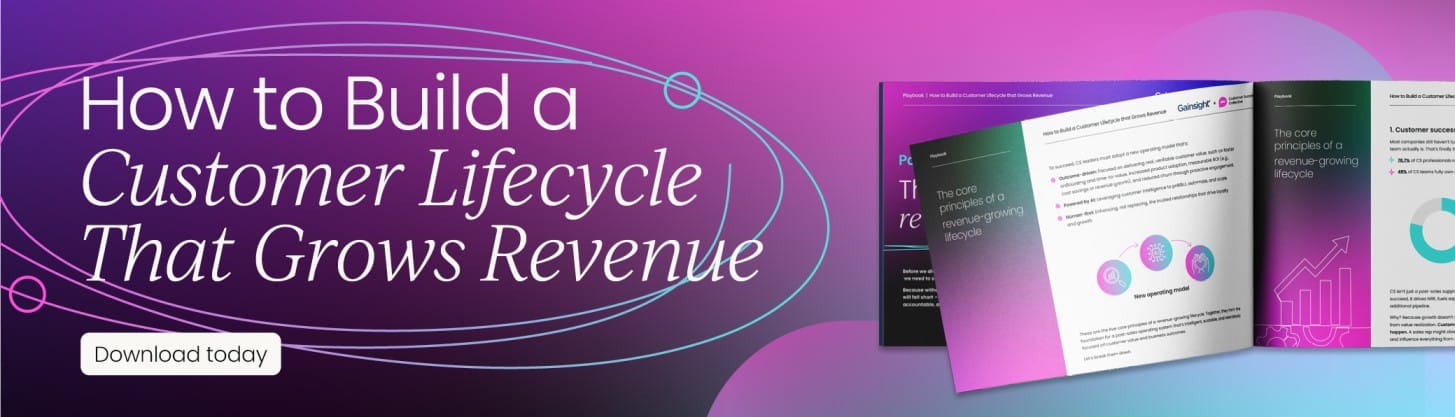
It covers the entire framework with AI-ready workflows, first-value milestones, and templates you can run this quarter. Don't miss out – grab yourself a free copy. 👇
1. Customer success as a strategic growth engine
Most companies still haven’t fully realized what a growth machine their customer success team actually is. That’s finally beginning to change: 78.7% of CS professionals now believe CS is a key revenue driver, and 49% of CS teams fully own all areas of expansion revenue, not just influence it.
CS isn’t just a post-sales support function. When done right, it doesn’t just help customers succeed, it drives NRR, fuels expansion, and turns customers into advocates that fuel additional pipeline.
Why? Because growth doesn’t come from licenses sold and product adoption. It comes from value realization. Customer success teams are in the best position to make that happen. A sales rep might close a deal, but a CSM can build a relationship that lasts years and influence everything from onboarding and adoption to renewals and referrals.
“As CSMs, we weather a lot of seasons with our customers – seasons of abundance, seasons of change, and uncertainty. Being present through those experiences allows us to gain the credibility necessary to be trusted advisors.”
– Christina Wold, Global Head, SMB Customer Success & Customer Value at SAP Concur
The best CSMs are so aligned with outcomes that they show customers how to unlock ROI, tie product value to business goals, and help execs make big decisions with confidence.
We’re watching CS evolve, from being seen as “everything” (or nothing) to a focused, revenue-driving function with real targets and clear impact. CS isn’t adjacent to revenue anymore.
It is revenue.
2. Human-first AI integration
Let’s be clear: AI is here to amplify, not replace, customer success.
Used right, AI doesn’t make CS less human; it makes it more powerful. It embeds intelligence into your workflows so you can do less admin and more high-impact work.
Give your customers (and team) a boost
AI helps keep the customer journey on track. It nudges users toward value, automates onboarding steps, flags red accounts, and handles the follow-ups customers need to continue toward verified outcomes.
All of that frees you up to do what you’re best at: being strategic, building trust, and ensuring that value is realized.
Work smarter, not just faster
AI sees what you might miss. It pulls insights from usage data, customer sentiment, and even external signals like layoffs or funding rounds. It surfaces opportunities and risks before they blow up, so you can act fast, with context.
You’re not reacting. You’re orchestrating.
Build a Customer Lifecycle That Grows Revenue
Short on time? Grab the PDF of our How to Build a Customer Lifecycle That Grows Revenue and access the five plays, milestone maps to time-to-value, and practical agentic-AI use cases. Then come back and cherry-pick what you need here.
Introducing… Agentic AI
Okay, this is where it gets exciting. Agentic AI refers to intelligent agents that operate autonomously. They don’t just surface insights. They make decisions, initiate workflows, and execute lifecycle plays without human intervention (but plenty of oversight).
Agentic AI is especially powerful in mid‑ and long‑tail segments, where high‑touch coverage isn’t scalable but consistent, proactive engagement still drives retention and expansion.
Think:
- Detecting expansion potential based on customer behavior and sending the right playbook
- Sending personalized outreach based on early churn signals
- Kicking off renewal workflows automatically
- Handling end-to-end renewals for certain segments
Gartner predicts that up to 80% of customer service issues could be handled by agentic AI by 2029.
That’s not science fiction… that’s your future operating model.
Your strategy needs three layers
To make this work, build an AI strategy that covers:
- Internal teams: Empower CSMs with insights, workflows, and prep tools
- Customers directly: Use chatbots, guides, and in-app help to serve at scale
- Fully automated tasks: Let AI handle repeatable workflows like renewals or QBR prep, especially in your long tail
Did you know that only 30.5% of customer success teams use customer health score automation, and only 15.9% automate adoption nudges? Based on data we revealed in the State of Customer Success Report 2025, there's clearly still a huge opportunity to scale these tactics.

3. Proactive, predictive, and personalized engagement
Customer success can’t afford to wait and react anymore. You’ve got to stay ahead of problems, spot opportunities early, and make every interaction feel like it was made just for that customer.
That’s where AI steps in.
Think ahead, act faster
AI eliminates much of the guesswork in customer engagement. Through analyzing product usage, engagement trends, NPS, CSAT, and other signals, AI can build predictive health scores, predict outcomes, identify trends, and trigger actions based on real-time signals.
It can flag accounts going quiet, highlight potential churn risks, or even surface expansion-ready customers who are ready for additional features, seats, or upsells, all before anyone raises a hand. You’re not putting out fires anymore. You’re preventing them from starting.
Smart touchpoints that scale
Let AI do the heavy lifting on the backend. It can trigger automated (but personalized) outreach, update success plans based on new activity, and handle the check-ins you won’t always have time for.
And with agentic AI, you can even hand off things like low-touch renewals or engagement nudges. Think of it as a kind of digital teammate, one that coordinates lifecycle plays across different segments, channels, and roles. This technology is particularly potent in workflows and segments that are beyond what humans can realistically manage. (Emphasis on the human part!)
Way less admin, heaps more impact.
Personalization that doesn’t burn you out
AI makes one-to-many actually feel like one-to-one. It pulls in data like lifecycle stage, product usage, hiring signals, or funding news, and helps tailor every message, resource, or recommendation to the customer’s context.
So, no more generic email blasts. Just targeted and timely engagements that improve retention, increase product adoption, and generate expansion readiness.
4. Revenue alignment and executive sponsorship
If CS wants to be taken seriously as a revenue driver by the wider business, the first step is to align your CSM KPIs to tangible, financial outcomes – retention, upsell, and expansion.
NRR is your North Star here. It tells the full story: Are you keeping customers, growing them, and protecting against churn?
The argument of aligning CS teams to hard, revenue metrics is compounded by Jasmine Reynolds, Director of Enterprise Customer Success (Strategic Lead) at
Appfire, in her keynote session at Customer Success Summit Washington 2025:
“It isn't about turning customer success into sales; it's about monetizing the value we already create. This result happens because CS has built trust and understands the customer's outcomes deeply. And we're already doing it.
“But in most situations, CS teams are held back because they’re probably afraid to have those conversations about money and negotiations. It’s my belief that we should break down that silo.
"We need to shift from just being focused on driving that value, but driving to that value so that we can eventually expand that account in a reasonable way.
“It may not be a year. It may not be two years. It may be longer, but I'm saying that the value that you build is actually monetary.”
Here’s the thing: customers don’t need to be “sold to” again. They should have already realized the value of your product.
Some orgs are even tying CSM compensation models to this shift:
- CSMs are incentivized for retention and sales team performance
- Growth targets baked into books of business (e.g., 15% net growth)
- CSQLs counted as pipeline-generating contributions
To operationalize this shift, you need executive buy-in early. Translate your CS wins into things they care about: annual recurring revenue (ARR), margin, lifetime value (LTV).
Still, there’s work to be done, with only 64.6% of CS leaders feeling their role is valued by the C-suite, indicating a lingering disconnect between CS impact and exec-level visibility.
Julie Fox, Global Director of Customer Success at Cin7 shared a moment at Customer Success Summit Chicago that perfectly captured what revenue alignment really looks like in action.
During an internal QBR, Julie noticed the sales leader openly discussing challenges in hitting their targets. Rather than just reporting that her CS team was on track, she seized the opportunity to reframe the conversation, and the impact was immediate.
“I was able to say, ‘Hey, what would happen if we exceeded our goals? What if we saved an additional ten customers per month? Or increased upsell from this amount to this amount?’ “I did the math for them and said, ‘If I can do these things, we’re still going to hit our goals – even if sales stay at the exact pace they’re at.’ That was the moment the CEO and my leadership started to sit up straight and say, ‘Tell me more.’”
Julie didn’t just share CS metrics. She translated customer success into business impact, showing exactly how CS could close the gap if sales came in light, and proving that CS deserved a seat at the strategic table.
5. Standardized, scalable, and iterative processes
But sustainable growth demands something better: processes that are standardized, scalable, and built to evolve.
It all begins with a playbook. Not some rigid manual gathering dust, but a living framework tied to commercial outcomes that guides your team while staying nimble enough to adapt as you learn. The secret is starting small. Test what works, measure the results, and only scale once you've perfected the approach.
Think of it like product development:
- Launch the minimal viable product
- Collect feedback
- Iterate fast
- Scale what actually works
When you design your lifecycle this way – testing onboarding flows, health score models, engagement cadences – you build a system that improves over time instead of breaking under pressure.
But here’s the catch: not all customers need the same motion. What works for your top enterprise accounts might not work for your SMB clients.
This is where segmentation matters. Strategic accounts might need a dedicated CSM,white-glove onboarding, and strategic depth. Smaller accounts? They might thrive with a digital journey, speed, and smart self-serve.
One size never fits all, and trying to force it will just slow your team down.
So, instead, try to build with modularity in mind:
- Standardize the objectives and outcomes
- Customize the engagement methods, timing, and channels
- Automate wherever possible, but keep a human in the loop where it counts
And don’t forget to bake in feedback loops. From customers and your own team. That’s how your lifecycle stays current – even as your product evolves, your ICP shifts, or your CS org doubles in size.
Forge industry alliances and become unbeatable
Looking for the full, actionable low-down on building partnership strategies?
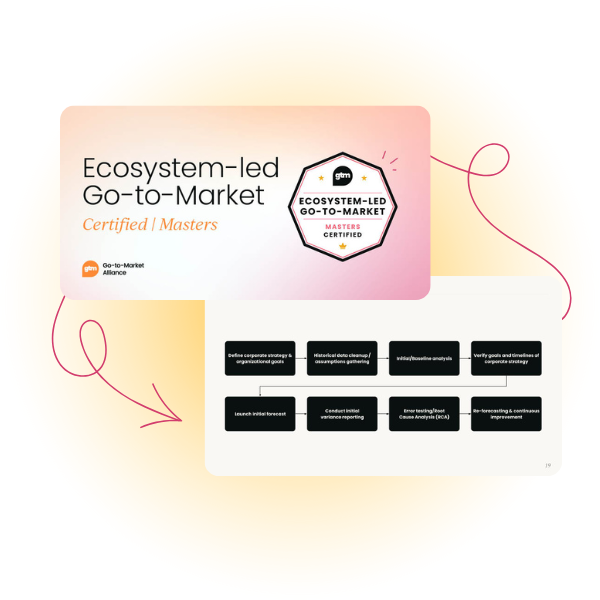
Sign up to Ecosystem Go-to-Market: Masters and Reach new audiences, amplify your messaging, and finally sell at scale when you learn how to leverage strategic partnerships the right way.


Go-to-Market alliance insider
Thank you for subscribing
Level up your go-to-market alliance career & network with go-to-market alliance experts.
An email has been successfully sent to confirm your subscription.
 Follow us on LinkedIn