

Pricing in product-led businesses has become harder to standardize for a simple reason: value is no longer delivered in a single, predictable way.
Some products operate like infrastructure and are expected to be always on. Others create value through usage, automation, or measurable outcomes. With AI now layered into most SaaS products, many are doing all three at once. That shift is what’s pushing companies to rethink how they price.
Across the market, this has led to a mix of models. CPCU remains common in performance-driven environments, credit systems are widely used in AI products, seat-based subscriptions still anchor traditional SaaS, and hybrid structures are becoming more visible across categories.
Teams often try to answer that through months of A/B testing, but product and market dynamics tend to move faster than clean conclusions. A more practical approach is to combine available research with real-world patterns observed in the field.
When value stops being predictable, pricing has to follow
One of the more consistent observations across recent research is that pricing is increasingly tied to how value is consumed, rather than how software is packaged.
McKinsey puts it quite directly: “AI-enabled software is accelerating the shift from subscription-based models toward usage- and outcome-based pricing.”
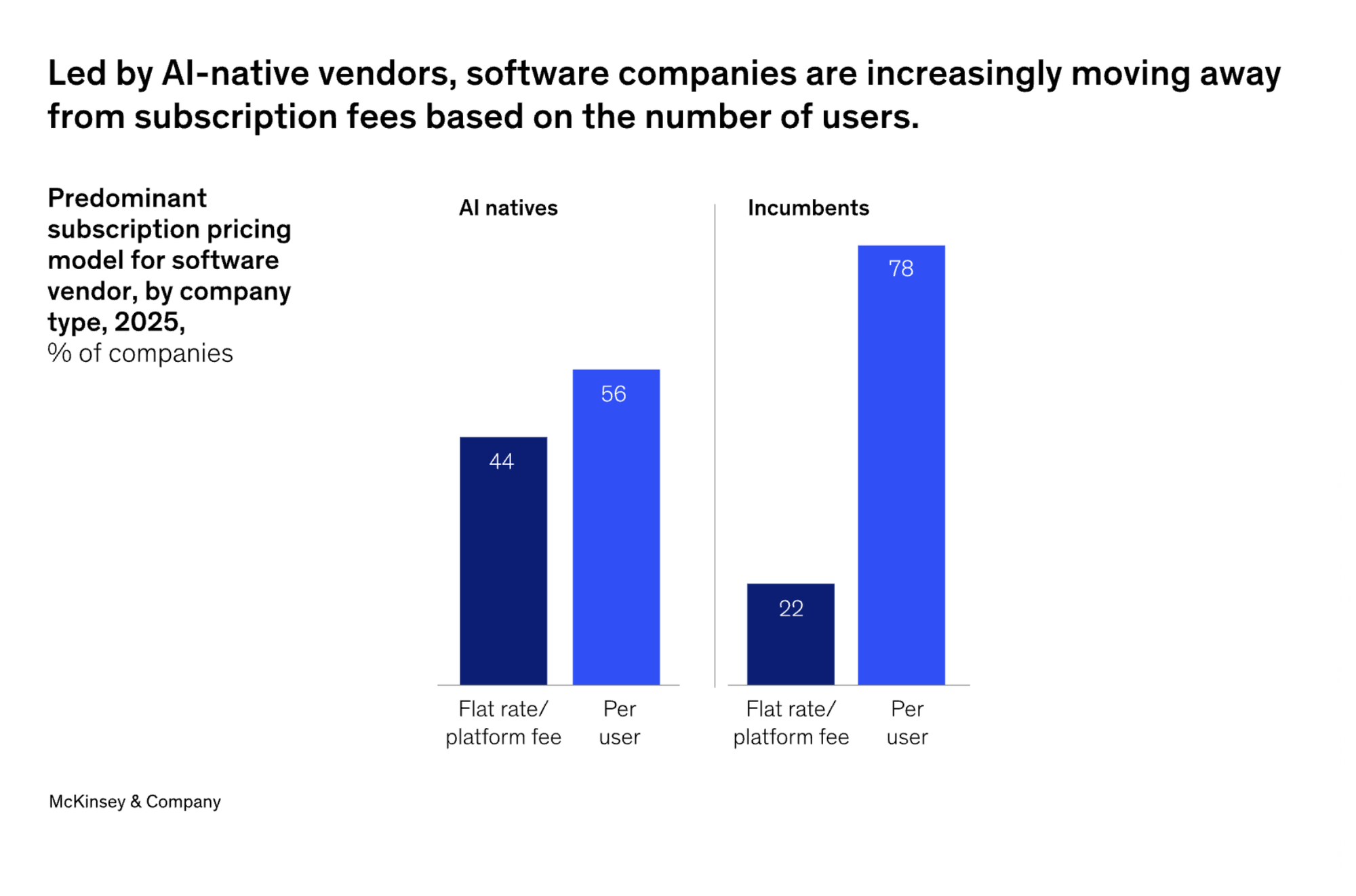
That shift is easy to see in practice. When a product’s output depends on how often it is used, how complex the task is, or how much performance it drives, a flat subscription starts to feel disconnected from the value it creates.
At the same time, the buyer has not changed as quickly as the product.
The budget problem pricing flexibility doesn't solve
Even as pricing becomes more flexible, the way companies buy software remains relatively structured.
Budgets are still planned annually, procurement still requires defined commitments, and finance teams need to understand how costs behave over time. Companies are also accountable for quarterly reporting, which makes fully variable, pay-as-you-go models harder to manage at scale.
The difference becomes even more pronounced when spending moves from thousands to millions. That is typically the point where the priorities of an enterprise buyer become clearer.
L.E.K. describes this tension in fairly practical terms:
“Enterprise customers often prefer pricing models that provide predictability and budget control, even when consumption-based models better align with value.”
This is where many go-to-market efforts begin to slow down. A model that feels intuitive to a growth team can become difficult to approve once additional stakeholders are involved.
It becomes even more noticeable in environments where attribution is not perfectly clean. If multiple tools influence performance, or if incrementality is debated internally, buyers tend to lean toward pricing structures that reduce uncertainty rather than amplify it.
Why credit-based and CPCU models win early
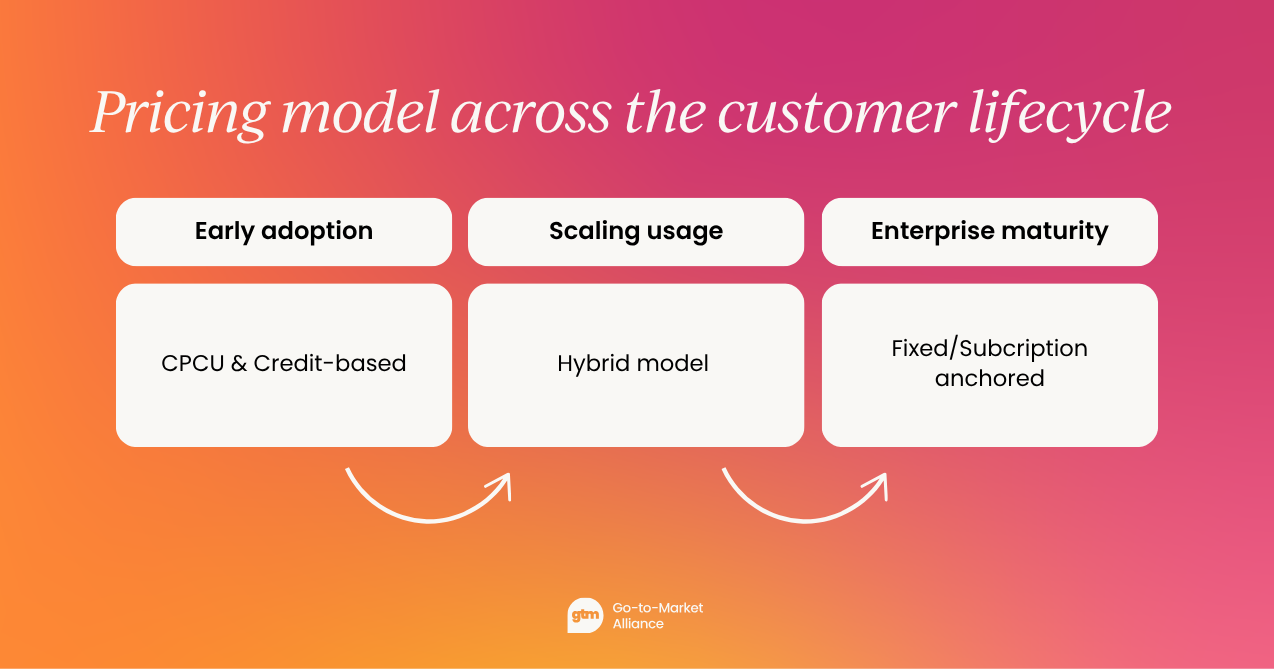
In earlier stages of the customer lifecycle, flexibility tends to work in your favor.
CPCU models resonate when performance is visible and measurable because they match how growth and acquisition teams already think about spend, which makes them easier to introduce without long approval cycles.
Credit-based systems play a similar role in AI-driven products. They allow teams to start small, experiment, and expand usage as value becomes clearer. That is one reason the model has spread so quickly.
- Lovable, which prices around monthly credits, rollovers, and top-ups, said in July 2025 that it had passed $100 million in ARR, and by February 2026 it had reached $400 million in ARR.
- Anthropic’s Claude API and Claude Code also rely on prepaid usage credits, and Anthropic said in February 2026 that Claude Code alone had grown to more than $2.5 billion in run-rate revenue.
These examples do not prove that credit-based pricing by itself creates growth, but they do show that flexible usage-led monetization can scale rapidly when the product delivers immediate value.
At the same time, a pattern starts to emerge as usage grows.
According to a16z, customers like usage-based pricing in theory but struggle to predict and control their bill in practice.
That tension becomes more visible once a tool moves from experimentation into regular operating spend, which is precisely when finance teams and enterprise buyers begin pushing for more structure.
Why fixed pricing reappears at scale
As adoption deepens, the conversation often changes.
Teams that initially focused on flexibility begin to look for clarity. Instead of asking how much value they can generate, they start asking how predictable the cost will be over time. That is where fixed pricing, or at least a fixed component, becomes more relevant.
That shift is already visible in how companies are structuring pricing today. But as Bain notes, hybrid models have emerged as a dominant interim approach, blending traditional subscription elements with usage or outcome-based components.
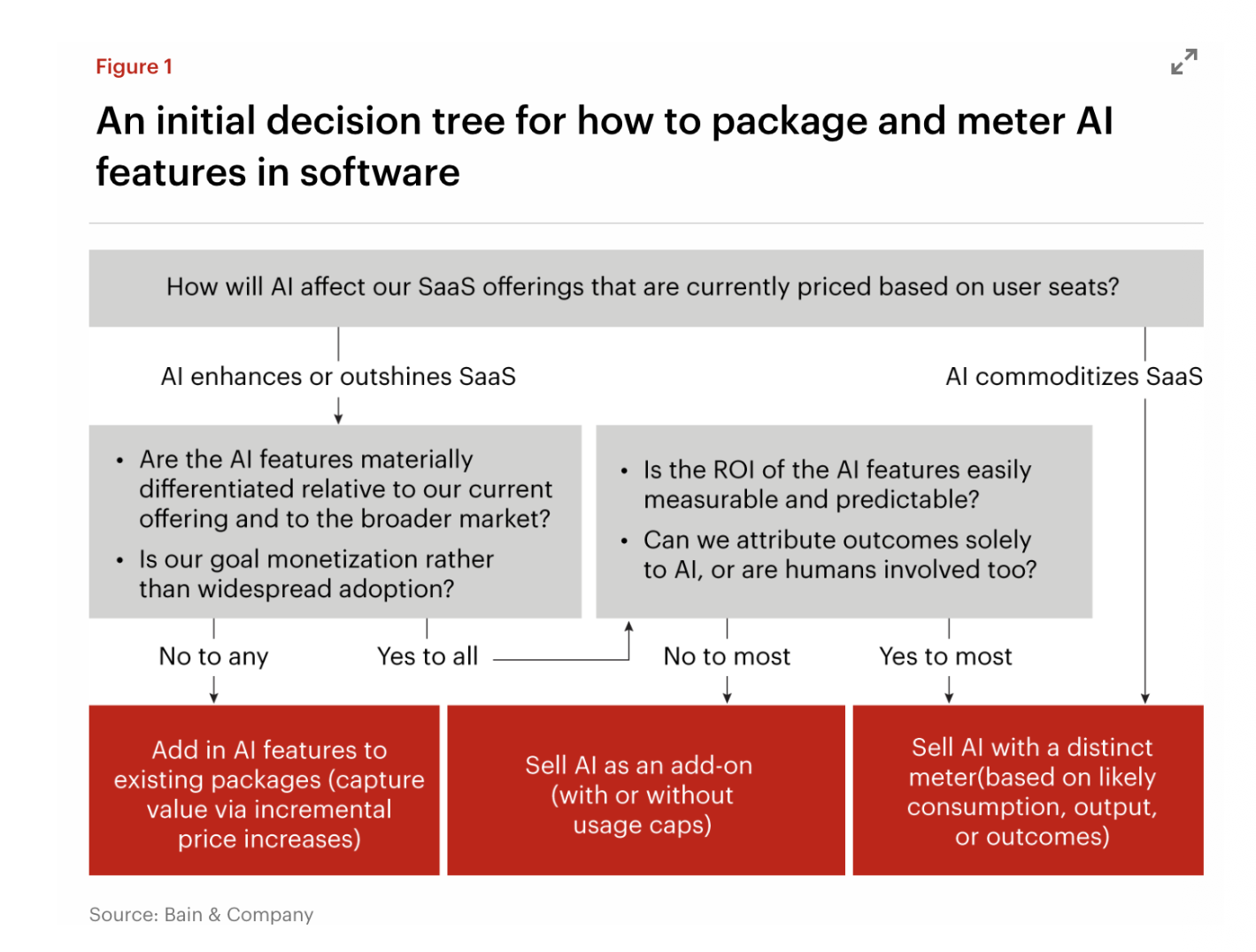
What tends to happen in practice is less about replacing one model with another and more about layering them.
A base subscription creates a stable foundation. Usage or performance elements sit on top, capturing additional value without removing cost visibility entirely.
Looking at it through an adtech lens
When a product has a direct and measurable impact on campaign performance, starting with CPCU tends to make sense. It aligns with how performance teams already evaluate success and lowers the barrier to initial adoption.
As the product expands into automation or AI-driven workflows, the value becomes more usage-driven rather than purely outcome-based.
At that stage, a credit-based layer can support broader adoption, especially while teams are still defining how deeply the product fits into their workflows.
As usage stabilizes and the account grows, additional stakeholders typically get involved, and the conversation begins to shift toward structure.
Introducing a fixed component, or moving toward a hybrid model, helps align with how larger organizations plan budgets and manage spending over time.
This progression reflects a broader shift driven by AI.
Pricing is increasingly behaving like the rest of go-to-market: it evolves.
The first interaction with a customer often benefits from flexibility. Long-term relationships tend to require more structure.
Designing for that transition, rather than trying to solve everything with a single model from the start, is where many companies are now focusing their attention.


Go-to-Market alliance insider
Thank you for subscribing
Level up your go-to-market alliance career & network with go-to-market alliance experts.
An email has been successfully sent to confirm your subscription.
 Follow us on LinkedIn