
In every enterprise opportunity, your champion has to sell your idea to finance, security, procurement, and the leaders who will carry the risk if it goes wrong. If your narrative can’t survive that internal journey, you pay the hefty cost of inaction and no decision.
All because one of these parties struggled to pitch your solution.And that’s why the AI revolution in GTM isn’t about automating emails. It’s about hyper-personalizing the narrative to match the buyer’s reality so closely that alignment becomes the path of least resistance.
Remember that the best story wins
One of the most famous direct mail pieces in history is Gary Halbert’s Coat-of-Arms letter, a simple message that made people feel pride, identity, and curiosity so strongly they acted.Halbert didn’t “sell paper.”
He sold a story that people wanted to be true about themselves.
Enterprise GTM works the same way.
Your buyer isn’t buying your features; they’re buying a believable future, with a safe path to get there.
The enterprise storytelling stack
Having been the first sales hire at POCIT, supporting early-stage startups in building their sales motion at Sell First Build Second, and now serving as Founding GTM at hyperGTM, I have consistently observed the same core concerns and questions coming up across customers, whether they’re Directors of Talent Acquisition or Chief Technology Officers.
Here’s the framework I now use to build narratives that actually hold up inside enterprise deal cycles.
The cost of the Status quo
Enterprise buyers don't buy "better"; they buy "less painful." If the status quo isn't bleeding, they won't move.
- The Goal: Name the cost in plain language.
- The Audit: What breaks? Who feels it? What does it block (revenue, speed, compliance)?
- CFO-Ready Template: “Today, we lose [Value/Metric] because [Existing Process] fails when [Specific Trigger] happens.”
The "Why Now" trigger
Market trends are interesting; quarterly constraints are urgent. Your "Why Now" must fall into one of three buckets:
- Strategic Shift: New region, new product motion, or M&A.
- Forced Constraint: Headcount freezes, budget scrutiny, or sunsetting legacy tech.
- New Risk: Regulatory changes (GDPR/AI Act) or security vulnerabilities.
The new mechanism
This is the "how." Avoid buzzwords like "AI-powered." Focus on the structural change that makes the result possible.
- Bad: "We use AI to optimize your outreach."
- Good: "We turn manual research into a workflow your team runs weekly, keeping human judgment in the loop while removing the 'scramble'."
De-risking the career move
Enterprise buying is career-risk management. Your proof must answer: "If this fails, will I look foolish?"
- Proof Assets: A success scorecard, a 30-day pilot plan, or clear guardrails.
- The Risk-Reversal Paragraph: “We will start with [Small Scope], measure [Success Metric], and only expand if [Outcome] is met. No long-term lock-in until the result is proven.”
The champion’s script
Equip your champion with three specific "mini-narratives" to handle internal friction:
- Upward (The Boss): Focus on the business case + risk control.
- Sideways (Peers): Why this helps them without adding to their backlog.
- Downstream (Procurement/IT): Why this is safe, standard, and easy to deploy.
 Go to Market Alliance
The power of narrative in GTM
Research by Annette Simmons suggests that people don’t actually want more information; they want a path to "faith" in your solution. In enterprise sales, product features are commodities, it is the narrative that builds trust and closes the deal. Leveraging Simmons’ six story types from The Story Factor helps move buyers through conviction rather than sales theatrics.
1. The "Who I Am" story (Credibility)
Use this for category creation and building executive trust. It humanizes your expertise by showing your evolution.
Template: "I used to believe [Old Way], until I saw [Pivot Point]. Now, I realize that [New Perspective] is the only way forward."
2. The "Why I’m Here" story (Intent)
Use this for outbound outreach to disarm skepticism. It proves you aren't just selling, but identifying a known market pattern.
Template: "I’m reaching out because teams like yours are seeing [Specific Pattern], and it’s currently showing up as [Direct Impact]."
3. The Vision story (Future)
Use this for strategic accounts and leadership alignment. It paints a picture of a world where current pains have been deleted.
Template: "Imagine if your team could achieve [Major Outcome] without the typical trade-off of [Common Pain/Cost]."
4. The Teaching story (Belief)
Use this during demos and in sales decks. It uses a "case study" format to show how others overcame surprises or failures.
Template: "A team tried [Strategy X]. The surprise was [Problem Y]. Here is how we implemented [Fix Z] to save the project."
 Ella Harrison
5. The "Values-in-Action" story (Trust)
Use this to ease friction with security or procurement. It demonstrates integrity by showing how you behave when things get difficult.
Template: "When [Critical Issue] happened, we took [Principled Action], even though it cost us [Resource]. Here’s why we did it."
6. The "I Know What You're Thinking" story (Objections)
Use this for late-stage deals or internal pushback. By naming the objection first, you strip it of its power and show empathy.
Template: "You might be thinking [Common Objection]. We thought that too, until we saw [Proof/Data] that changed our minds."
Conclusion
I’m a firm believer that AI shouldn’t be used to lower quality at scale, but to raise it, and by helping teams build stronger GTM narratives and uncover insights that ensure the story survives when we’re no longer in the room.
Enterprise deals are still decided in budget reviews and risk meetings you’ll never attend. In those moments, your champion is the product, and your narrative is the only thing speaking for you.
The teams that win won’t have better decks. They’ll have stories that travel, because in enterprise, the best story doesn’t just sound good. It closes.
Forge industry alliances and become unbeatable
Looking for the full, actionable low-down on building partnership strategies?
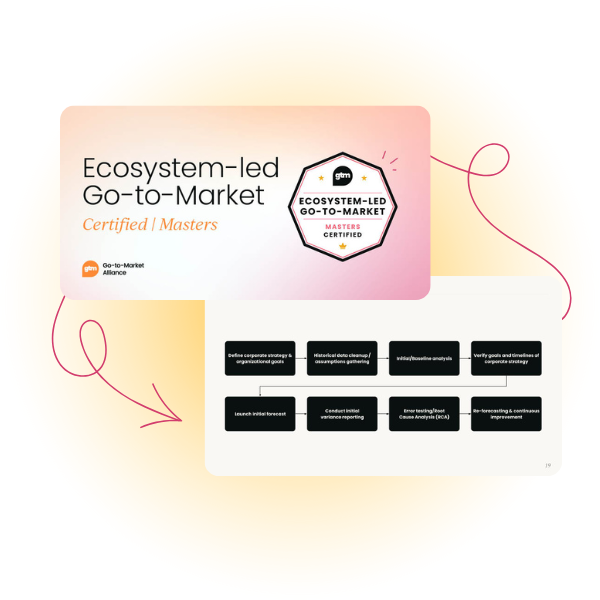
Sign up to Ecosystem Go-to-Market: Masters and Reach new audiences, amplify your messaging, and finally sell at scale when you learn how to leverage strategic partnerships the right way.


Go-to-Market alliance insider
Thank you for subscribing
Level up your go-to-market alliance career & network with go-to-market alliance experts.
An email has been successfully sent to confirm your subscription.
 Follow us on LinkedIn