

At one point, I realized we didn’t have a demand problem. We had a conversion problem.
Users were signing up. Demos were happening. Product usage looked promising on the surface.
But too many opportunities were stalling between initial interest and actual expansion.
In some cases, users were clearly getting value from the product, but momentum disappeared before conversations ever turned into commercial outcomes.
I started looking more closely at where those opportunities were breaking down.
The issue usually wasn’t product quality. It was operational.
No clear ownership. No enforced next step. Slow follow-up. Weak visibility into which users were actually showing expansion potential.
Once I started building systems around progression, follow-up, and user behavior, conversion improved materially.
That shift changed how I think about revenue in AI companies entirely.
Why early AI traction often fails to convert
Most AI companies today have:
- Inbound interest
- Product usage
- Demos booked
- A vague sense that “something is working”
What they don’t have is a revenue engine. No structure. No ownership. No system that reliably converts interest into revenue.
They have activity. Which is comforting. Because activity feels like progress…

The highest risk point in the revenue process
The failure point is almost always the same:
The moment between interest and conversion.
- A lead comes in, but your response is slow
- A demo happens, but there is no clear next step
- A conversation starts (yay!), but then there’s no follow-up
Then everyone wonders why “conversion is lower than expected.”
Nothing broke. You just never built the system that makes it work.
In my case, the issue wasn’t conversion, but it started earlier. Inbound was inconsistent, ICP was still being defined, and demand channels were still being tested, from where users were actually searching to early marketing and targeted acquisition efforts.
 Eleonora Berylo
I moved from chasing volume to understanding behavior. I reviewed users individually, mapped how they were actually using the product, and fed that directly into product changes, from capturing company data to improving onboarding and usability.
From there, I built a bottom-up motion. Starting with individual users, identifying internal champions, expanding into their teams, and shaping pricing around real usage and willingness to pay.
What began as beta usage turned into paying users, then team adoption, and eventually enterprise-level conversations, including discussions at the CEO level for company-wide rollout.
None of this came from more features or more leads. It came from building a system around how demand was created, understood, and converted.
Most teams would have called this “early traction.” It wasn’t. It was unstructured demand, and without intervention, it wouldn’t have converted.
Conversion improved materially once pricing, ownership, and follow-up were systemized.
“We’re still finding PMF” often hides execution problems.
This is the most overused line in early-stage companies.
PMF is often treated like the Holy Grail: find it once, and everything else is supposed to fall into place.
It doesn’t.
It’s not static. It shifts as your market, customer, and product evolve. More importantly, you don’t discover it by waiting.
You discover it by putting a system around demand and learning from what converts and what doesn’t. If you don’t have a way to consistently follow up, close, and learn…
You don’t have product-market fit.
You have opinions.
Elena Verna puts it more bluntly: product-market fit isn’t a milestone you unlock, especially in markets that are still shifting. Even companies doing hundreds of millions in revenue aren’t guaranteed their position.
If that doesn’t make you uncomfortable, it should.
Thomas Doherty
What I built to turn product usage into revenue
It’s not your CRM. It’s not your pipeline dashboard. Or your unpersonalized, bland, AI-generated cold outreach emails that can’t handle my fada.
It’s not a meeting cadence or a reporting layer. It’s an operational system with defined ownership, clear stages, and enforced next steps.
Every interaction moves forward or is explicitly closed.
Every opportunity has a clear owner and every delay is visible and addressed. Delays are where opportunities decay.
Without this, the pipeline is just activity without progression.
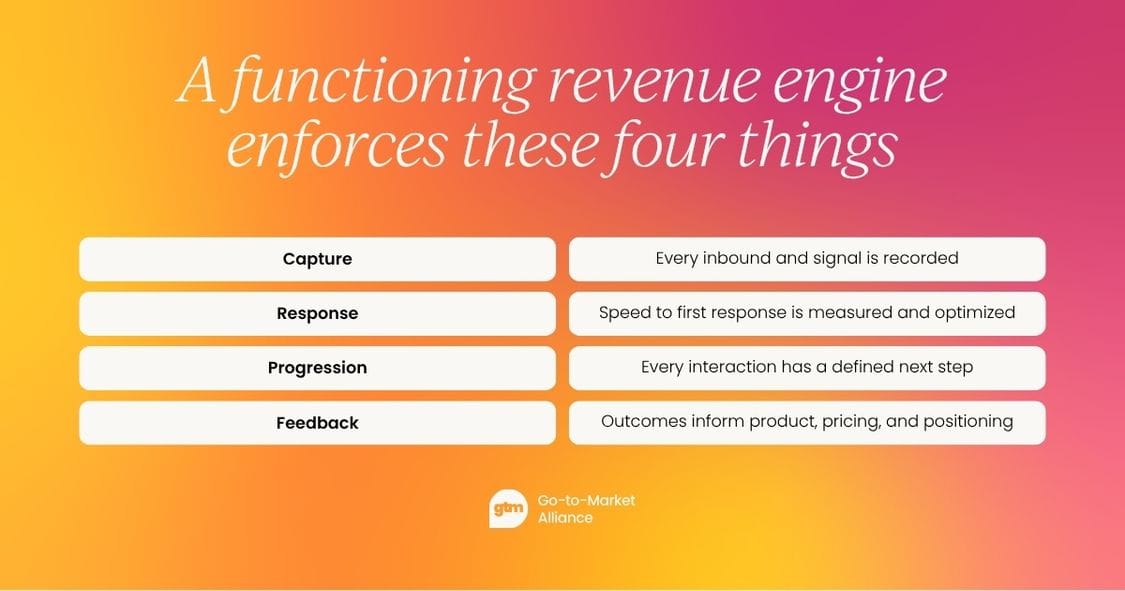
At a minimum, a functioning revenue engine enforces four things:
- Capture: I stopped treating inbound as a volume game and started treating it as a signal analysis problem. Every inbound lead, user interaction, and product signal was logged and reviewed manually. I tracked where users came from, what acquisition source drove them, what features they used first, how often they returned, whether they invited teammates, and which accounts showed signs of expansion potential.
I also pushed for better internal tracking inside the product itself. We needed clearer company identification, better visibility into user behavior, and cleaner attribution between product usage and commercial opportunity. Without that, it was impossible to know where real momentum was actually forming. - Response: I treated speed to first response as a conversion variable, not a support function. High-intent users were contacted while interest was still active, often within hours. I used whatever channel created the fastest response loop: email, text, phone calls, LinkedIn, or even out-of-hours follow-ups if timing mattered.
Waiting days to respond usually meant the opportunity had already cooled, or worse, we had successfully created initial interest only to lose the account to a competitor with a tighter commercial process. - Progression: Every interaction required a defined next step before the conversation ended. Not “Let's reconnect soon.” An actual progression event tied to movement: onboarding additional team members, scheduling workflow discussions, reviewing pricing, introducing decision-makers, or expanding usage into other parts of the company.
If momentum slowed, I did not wait passively for the next reply. I picked up the phone. I sent the follow-up text. I called again. I used LinkedIn if necessary. The goal was not pressure. It was maintaining momentum while intent still existed.
Operationally, I tracked where opportunities stalled, which conversations repeatedly lost momentum, and which accounts consistently progressed toward expansion. That visibility made it easier to identify friction points early instead of discovering them months later in lost pipeline. - Feedback: Product, pricing, onboarding, positioning, and expansion strategy were adjusted continuously based on real user behavior. I paid close attention to where users stalled, what objections repeated, which features drove retention, and where team adoption naturally started to emerge.
That feedback loop directly shaped product decisions, onboarding improvements, pricing structure, and how we positioned the product commercially. Instead of treating sales, product, and user behavior separately, I treated them as part of the same operating system.
This is where product-led growth either works or breaks.
Without these systems, product usage doesn’t translate into expansion or revenue.
And most importantly:
Follow-up eventually became an operational system rather than a sales tactic.
After an initial conversation, every opportunity entered an active follow-up cadence. If someone showed strong usage patterns or commercial intent, I did not wait a week to reconnect.
The first follow-up usually happened within 24 hours, typically by email with a clear recap, next step, or onboarding action attached.
If momentum slowed, I quickly escalated channels. Text messages, phone calls, LinkedIn, WhatsApp, whatever created the fastest response loop while interest still existed.
Most opportunities received multiple touchpoints across several days, not because I wanted to pressure people, but because timing mattered. Interest decays quickly, especially in early-stage products where competitors are also moving fast.
The messaging also changed depending on where the opportunity was stalling.
If usage dropped, I focused on friction:
“Where is the workflow breaking?”
If engagement was strong but expansion stalled, the conversation shifted toward rollout:
“Who else on the team would benefit from this?”
If decision-making slowed, I focused on operational value:
“What would need to happen internally for this to become a broader deployment?”
The goal was not generic persistence. It was maintaining progression.
Most opportunities are not lost immediately. They decay slowly through silence, delayed replies, unclear ownership, and weak follow-up systems.
That is why follow-up became one of the most important operational layers in the entire revenue process.
It was still relationship-driven.
Sometimes that meant inconvenient meeting times, out-of-hours calls, or being willing to move quickly while momentum was still building.
Follow-up is not a tactic but a control mechanism
It ensures:
- Timing is leveraged, not missed
- Intent is maintained across conversations
- Opportunities do not decay between touchpoints
Most teams treat follow-up as optional. High-performing teams treat it as enforced.
Tobi Ogunmoyero
AI does not fix weak commercial systems
They think automation replaces effort. It doesn’t. It amplifies whatever system you already have.
If your process is loose, your priorities unclear, and your team misaligned… AI will scale that faster.
Clear focus. Tight processes. Aligned people. That’s the prerequisite.
McKinsey’s 2025 State of AI report makes the same point at enterprise scale: AI adoption is spreading, but only 39% of respondents report EBIT impact at the enterprise level. Adoption alone is not the same as value capture.
Even OpenAI shows the difference between demand and commercial systems at scale. ChatGPT reached 100 million monthly active users just two months after launch, making it the fastest-growing consumer application in history at the time.
OpenAI has since reported rapid revenue growth, but the broader lesson holds: usage is only the starting point. The real business is built through monetization, enterprise adoption, and repeatable commercial systems.
AI scales the process, but people still drive conversion
Revenue is still built on trust, relationships, timing and judgment.
None of which come from a workflow builder.
The best teams understand this:
- Systems create speed and consistency
- People create conversion
If your team can’t build relationships, handle objections, and move a deal forward with intent, no amount of AI will fix that.
You don’t need more automation. You need operators who know how to use it; to build relationships, move with intent, and convert at the right moments.
The truth most companies avoid
Most teams don’t have a demand problem. They have a conversion problem.
They don’t need more leads, features or awareness but they need a system that turns what they already have into revenue. That starts by actually looking at what’s already in front of you.
Get deep into your data.
Look at your current users and customers.
Where are you leaving value on the table?
Where are conversations starting but not finishing?
“Opportunity is everywhere” is my motto. A default setting, if you like. If you’ve ever worked with me, you’ve definitely heard me say it more than once. And unlike an LLM, I don’t just generate that line. I expect it to be acted on.
Most teams are so focused on chasing new demand, they ignore the revenue sitting right in front of them.
Consistent revenue comes from operational discipline
AI can create revenue. So can interest. So can a great product but none of them do it consistently. That’s the difference.
Consistency comes from systems.
Systems that capture demand, convert it, and follow up relentlessly. If you want to know whether your revenue engine is actually working, start here:
- Measure speed to first response across every inbound channel. Not daily averages, actual response time while intent is still active.
- Audit where opportunities consistently stall. Look for repeated drop-off points between demo, onboarding, expansion, and decision-making.
- Enforce a defined next step before every conversation ends. If no progression event is attached, the opportunity is already beginning to decay.
- Build visibility into user behavior, not just pipeline activity. Expansion signals usually appear in product usage before they appear in CRM stages.
- Treat follow-up as operational infrastructure. Create a repeatable cadence across email, phone, text, and LinkedIn, rather than relying on memory or motivation.
The companies that win won’t be the ones with the best product alone. They’ll be the ones that build a machine around it, one that turns moments of interest into repeatable outcomes.
Everything else is just… noise.
I write "From Model to Money" on LinkedIn, breaking down how AI products drive adoption, revenue, and scaled deployment.


Go-to-Market alliance insider
Thank you for subscribing
Level up your go-to-market alliance career & network with go-to-market alliance experts.
An email has been successfully sent to confirm your subscription.
 Follow us on LinkedIn